Research
Three of the largest changes to labor markets in the last decade have been unprecedented refugee flows in developing economies, changing immigration policies in developed countries, and the COVID-induced change in where work is conducted. My research covers all three. I have worked on the Syrian and Venezuelan refugee crises, high-skill immigration policies in the US and Canada, and how the adoption of remote work is impacting gender inequality across several countries.
JMP-1JMP-2Refugee CrisesRemote Work and Gender Inequality
Turkey received 3.6 million Syrian refugees, who mostly settled in the south-eastern regions close to the border. Suppose we want to understand the labor market consequences of this shock. The standard approach is to assume the effects are local and compare host to non-host regions before and after the immigration shock. However, these shocks are so large that they are likely to impact the prices of goods, which can then induce general equilibrium effects across the economy. If we want to understand the effects of immigration, we need to understand the G.E. forces it triggers.
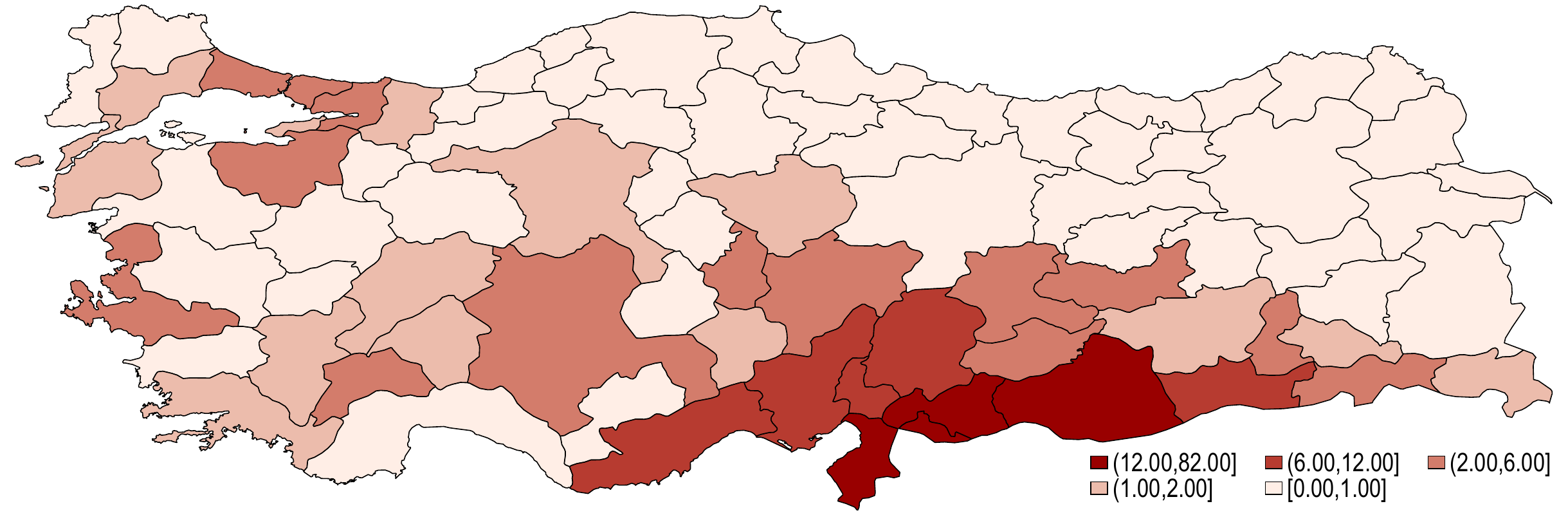
This is essentially what I do in my first job market paper. In a nutshell, I study the G.E. effects of immigration in three parts: theory, empirics, and counterfactuals. Theory characterizes the G.E. forces by which immigrants in one region impact firms in other regions. Empirically, I test the model's implications and estimate the key structural elasticities. I use counterfactuals to quantify the total effects of immigration. The main result of the paper is that when immigrants settle in large, central cities, their effects are global, not local. This intuition can guide policymakers on where to settle immigrants and refugees to maximize economic gains, and helps resolve a long-lasting puzzle in the immigration literature: why do we not have a consensus on how immigration impacts natives' earnings?
Theory
- i₁ supplies i₂; i₂ and i₄ supply i₃. Immigration lowers i₂'s labor costs and prices.
- G.E. force 1 (the cost shock propagates forward): i₃ demands more (less) labor if intermediate goods and labor are gross complements (substitutes).
- G.E. force 2 (demand spillovers from substitution among intermediates): i₃ reallocates its spending between i₂ and i₄ based on substitutability among intermediates.
- G.E. force 3 (two forces impact i₁): i₂'s input choice between labor and i₁'s goods, and i₃'s reallocation between i₂ and i₄.
Formally, I derive these forces by adding regional labor markets to a model of production networks. This was a more impressive feat when I first wrote the model, which was pre-AI 🙂. The details can be found in the paper.
Testing the theory
I compare firms in non-host regions that followed similar trajectories before the immigration shock but happen to be differentially exposed to immigrants through their trading partners. To do that, I combine synthetic controls with IV, a tool Jaume Vives-i-Bastida and I developed in another paper.
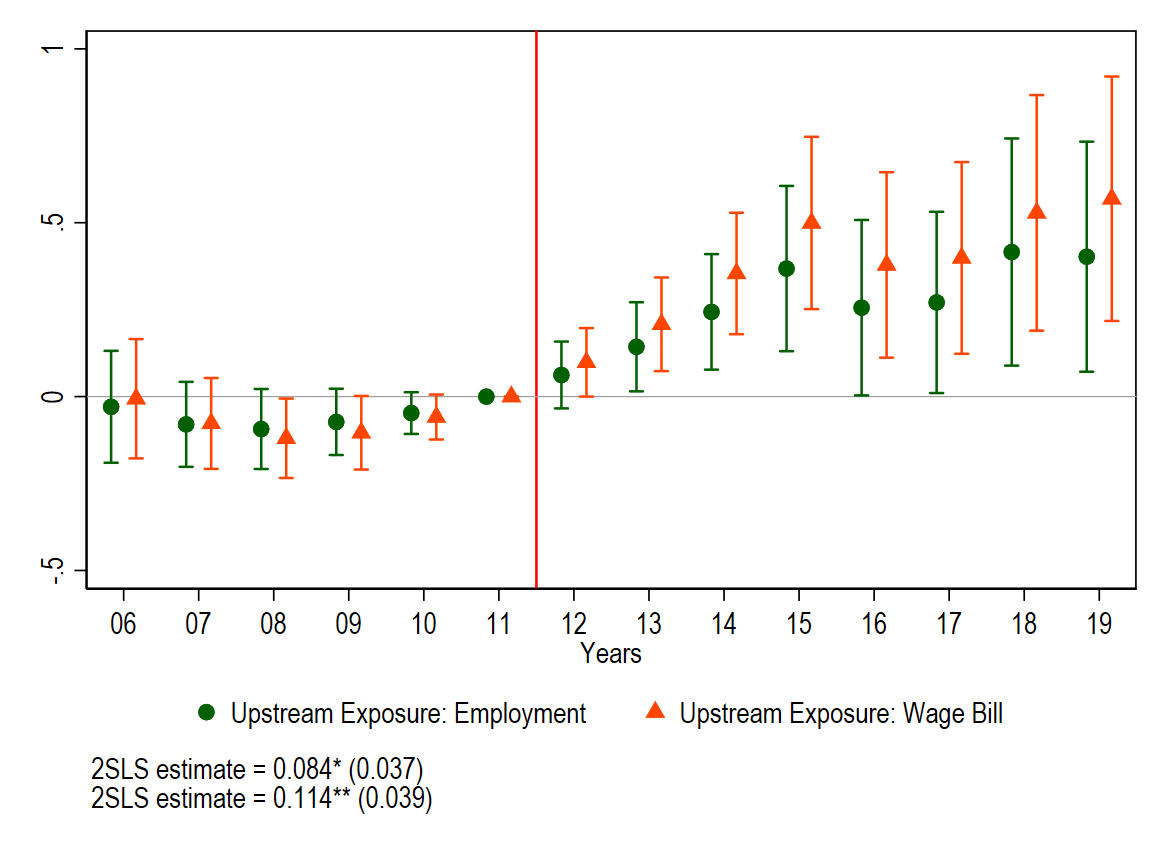
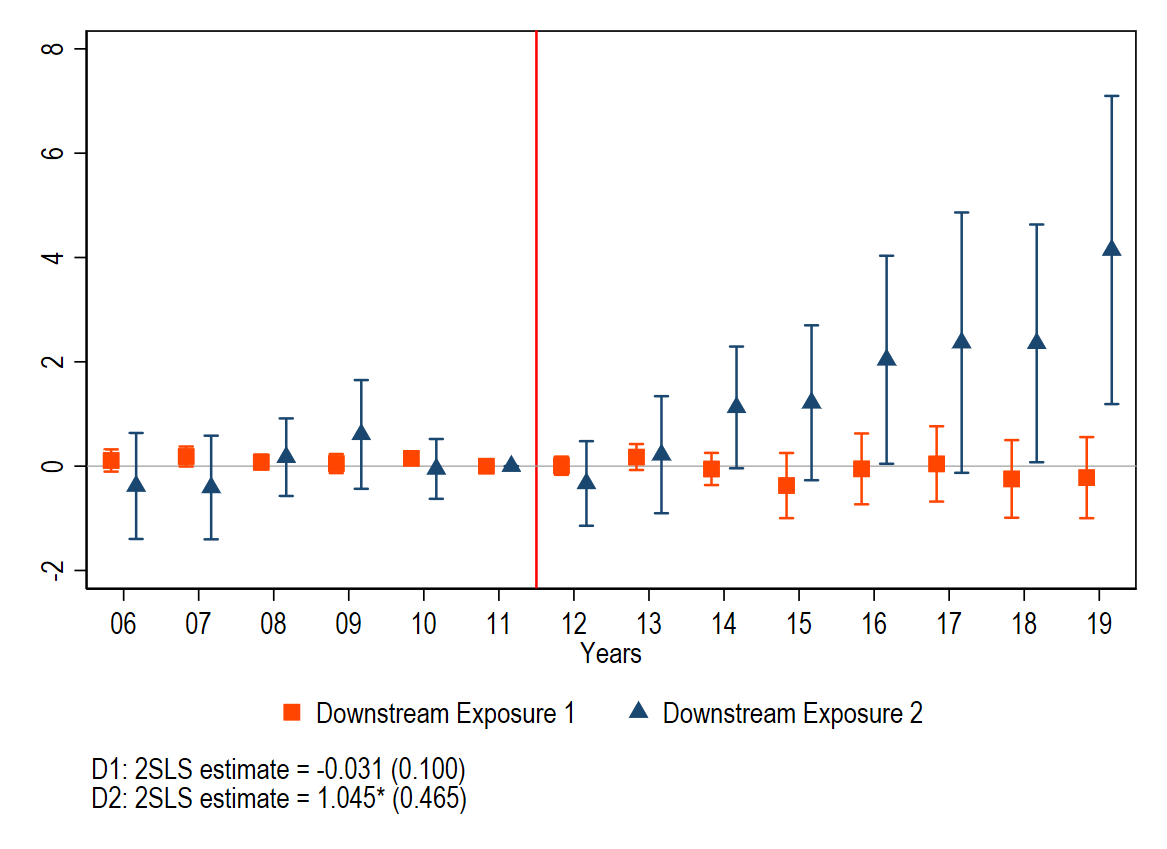
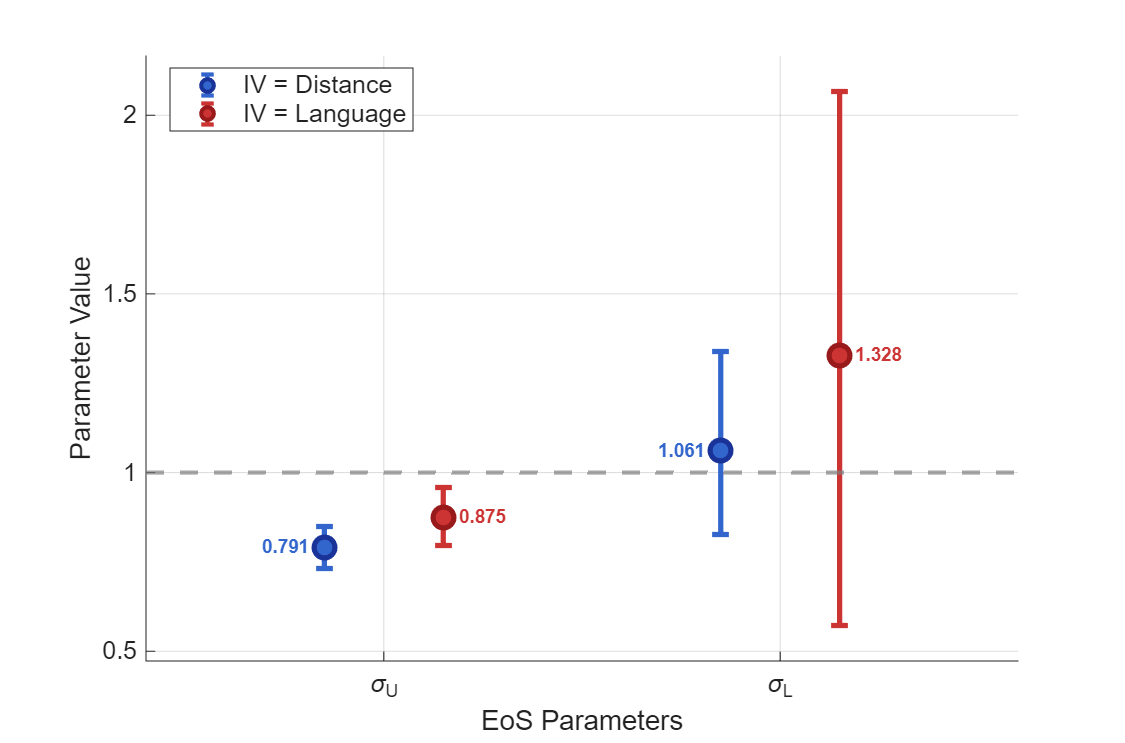
The model is overidentified, and the data does not reject it.
Counterfactuals
Given that spillovers exist, I ask: why should we care? How big are spillovers? I use the model to answer these questions.
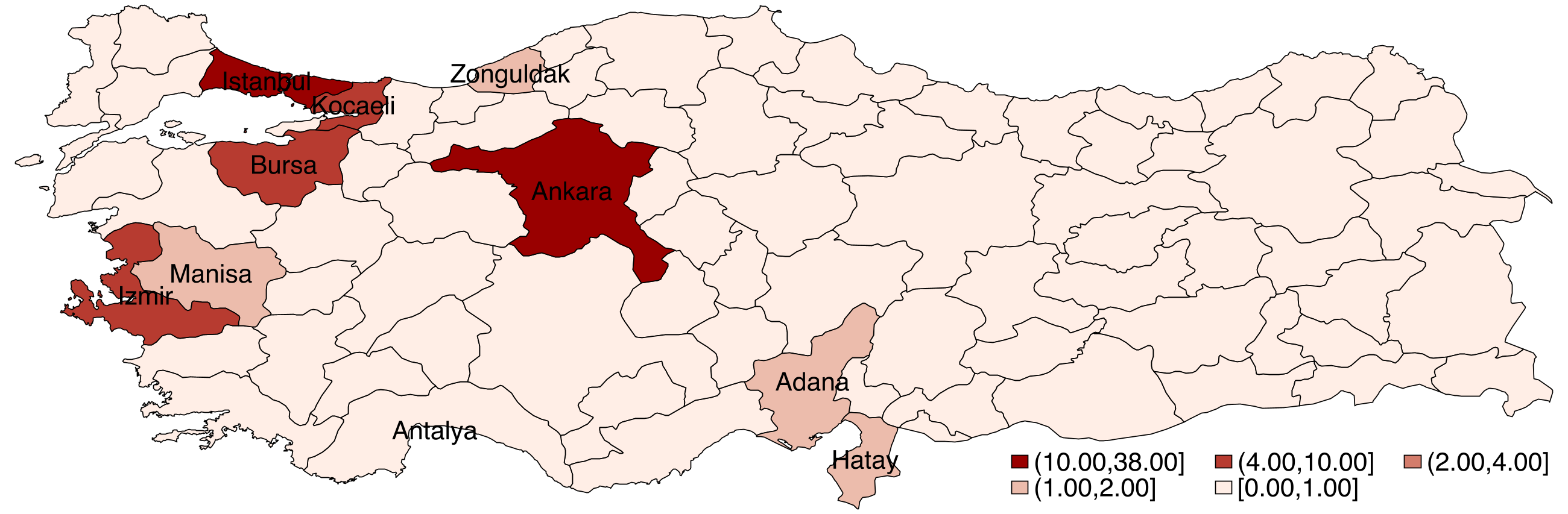
A 1% labor supply increase in Istanbul decreases local real wages by 0.56% while increasing non-host wages by 0.38%. For non-central regions, identical shocks reduce local wages by 1% with negligible spillovers. Similarly, high-skill immigrants create larger spillovers and, therefore, larger welfare gains than low-skill immigrants because high-skill-intensive industries are more central than low-skill-intensive industries.
This mechanism explains why studies comparing host and non-host regions can disagree. Economic migrants tend to settle in large cities, which tend to be more central. There, production networks dampen local wage effects, and spillovers bias comparisons between host and non-host regions in either direction, depending on the economy's technology parameters. Refugees, in contrast, settle close to the border they cross, in typically non-central regions where spillovers are negligible and such comparisons recover the effects of immigration. The contrast explains why studies of refugee crises find larger losses for natives than studies of economic migration, and why my Turkish and Colombian estimates, both identified by comparing regions near the border with regions far from it, find lower earnings for natives.
These results also bear on where governments should settle refugees and immigrants during mass migration episodes. In Turkey, settling migrants in central rather than non-central regions raises aggregate welfare by an order of magnitude. Existing placement policies weigh job availability and equity across regions, but not the position of host regions in the production network, resulting in forgone welfare gains.
Related papers
AEA Papers and Proceedings, forthcoming (May 2027).
Synthetic IV Estimation in Panels
With Jaume Vives-i-Bastida. [PDF]
We propose a Synthetic Instrumental Variables (SIV) estimator for panel data that combines the strengths of instrumental variables and synthetic controls to address unmeasured confounding. We derive conditions under which SIV is consistent and asymptotically normal, even when the standard IV estimator is not. Motivated by the finite sample properties of our estimator, we introduce an ensemble estimator that simultaneously addresses multiple sources of bias and provide a permutation-based inference procedure. We demonstrate the effectiveness of our methods through a calibrated simulation exercise, two shift-share empirical applications, and an application in digital economics that includes both observational data and data from a randomized control trial. In our primary empirical application, we examine the impact of the Syrian refugee crisis on Turkish labor markets. Here, the SIV estimator reveals significant effects that the standard IV does not capture. Similarly, in our digital economics application, the SIV estimator successfully recovers the experimental estimates, whereas the standard IV does not.
Production Network Propagation of Minimum Wage Shocks: Evidence from Turkey
Draft coming soon.
I study the 30% increase in Turkey's minimum wage in 2016 using the same administrative and survey data as my first job market paper. The minimum wage raised wages in both the formal and the informal sector, the latter because formal and informal workers are gross substitutes. Firms passed the higher labor costs through to the prices of the goods they produce. Firms more exposed to the minimum wage cut employment and exited at higher rates, and the effects propagated along the supply network: the suppliers and customers of exposed firms also shrank, the mirror image of my immigration results. Displaced workers moved to less exposed firms, especially those serving the domestic market, as customers substituted toward less exposed competitors. A production network model rationalizes these findings.
The policy debate around immigration in the United States (and in many other countries) is whether immigrants “steal” natives' jobs or bring unique talent that makes the economy more productive. The production network framework helps us answer this question.
A new test: cheap labor or better skills?
When labor and intermediates are gross complements, a pure labor supply shock makes both suppliers and customers better off, while a productivity shock makes mainly customers better off and actually hurts suppliers indirectly. Hence, how much more customers benefit than suppliers can help us quantify how much productivity gain immigrants bring.
Taking the test to H-1B
How can we use this intuition to test whether H-1B immigrants increase US productivity? The recent literature on H-1B exploits the visa lottery (Doran, Gelber, and Isen, 2022; Mahajan et al., 2024), which creates gold-standard variation for causal identification. However, the lottery does not let us look at input-output spillovers, for two reasons. First, the US does not have data on firm-to-firm transactions like Turkey does (a VAT system has its advantages). Second, which firms get the most H-1B workers changes over time: in the early 2010s, it was mainly Indian IT firms, and in more recent years, it is the tech giants.
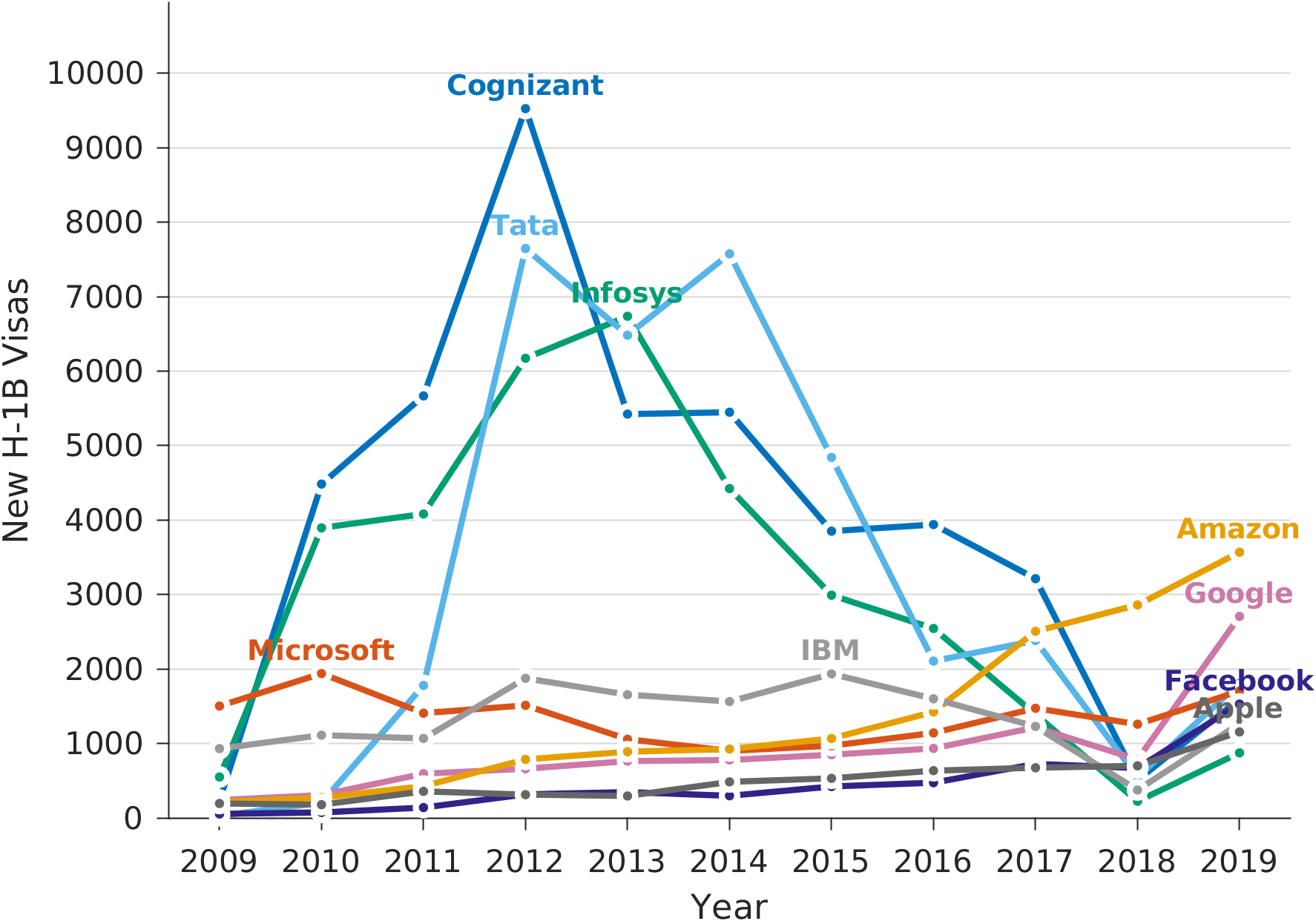
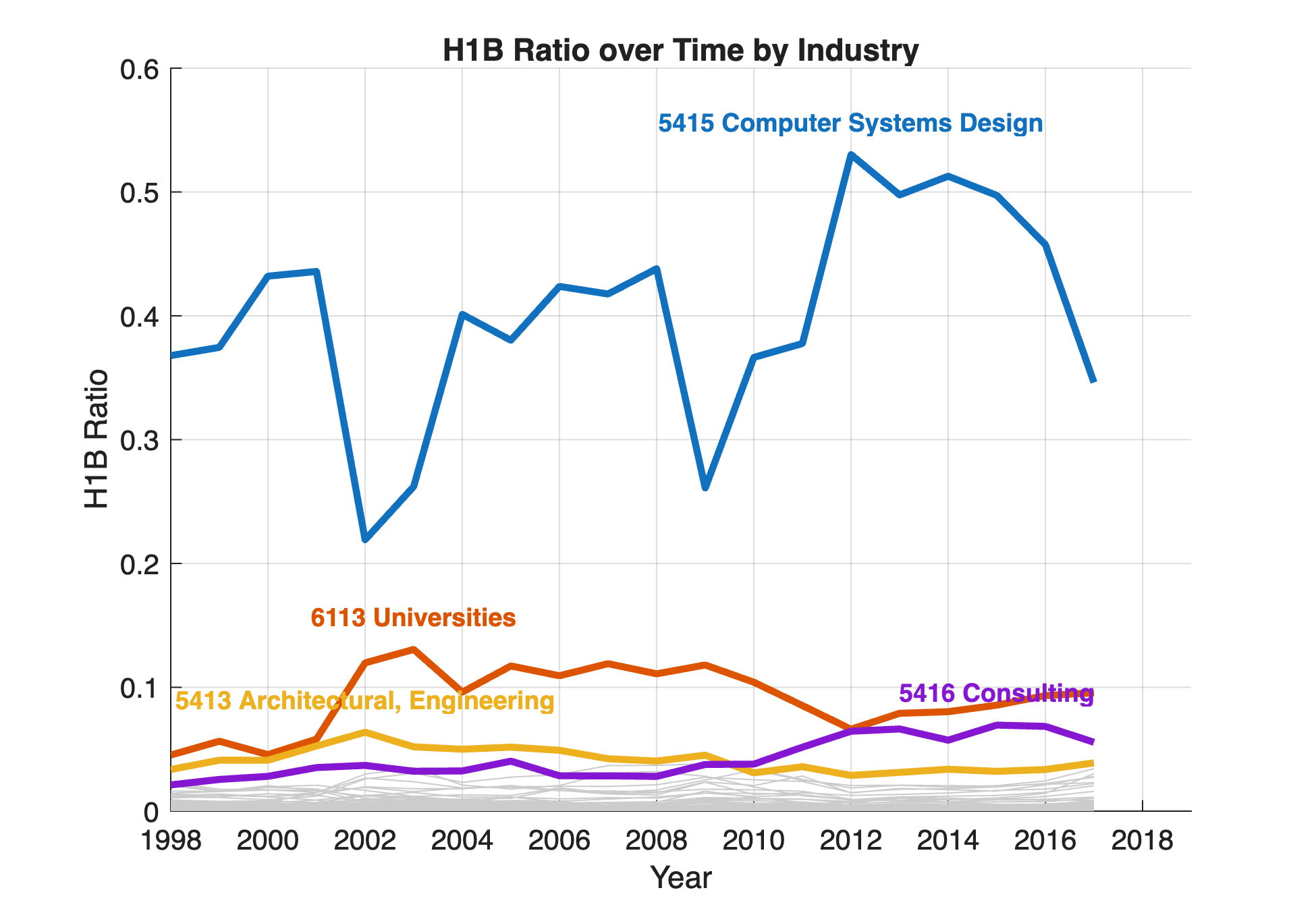
So, what can we do? The empirical intuition is that H-1B is first and foremost an industry policy. Which firms acquire H-1Bs changes over time, but which industries get the most H-1Bs does not: it is essentially a handful of industries that are most exposed.
The event we use is the relaxation of H-1B quotas between 1999 and 2003, which allowed for 490,000 additional visas during this period. The shock therefore left these industries highly exposed. Because we observe the US industry-level input-output network, we can trace forward and backward propagation.
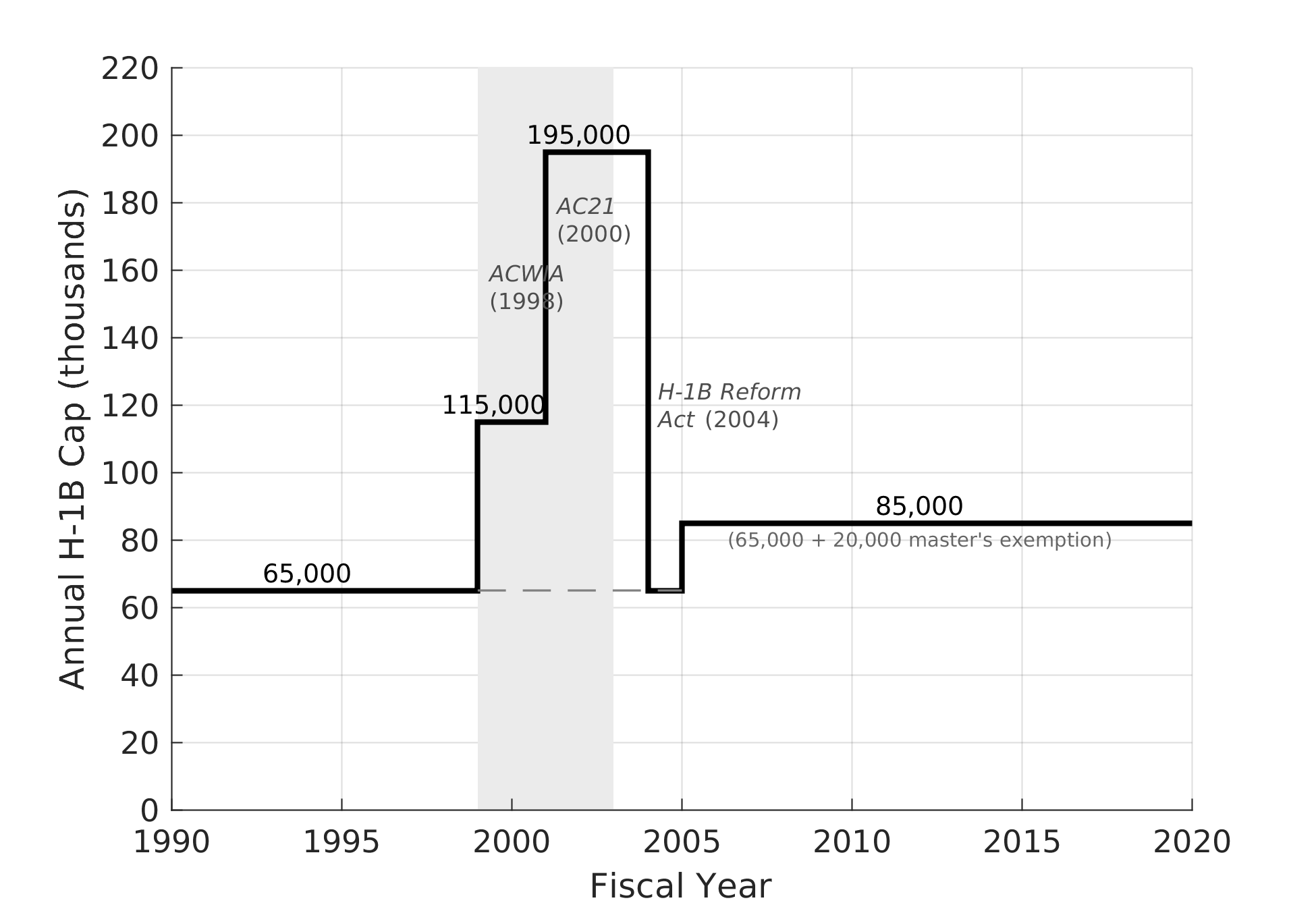
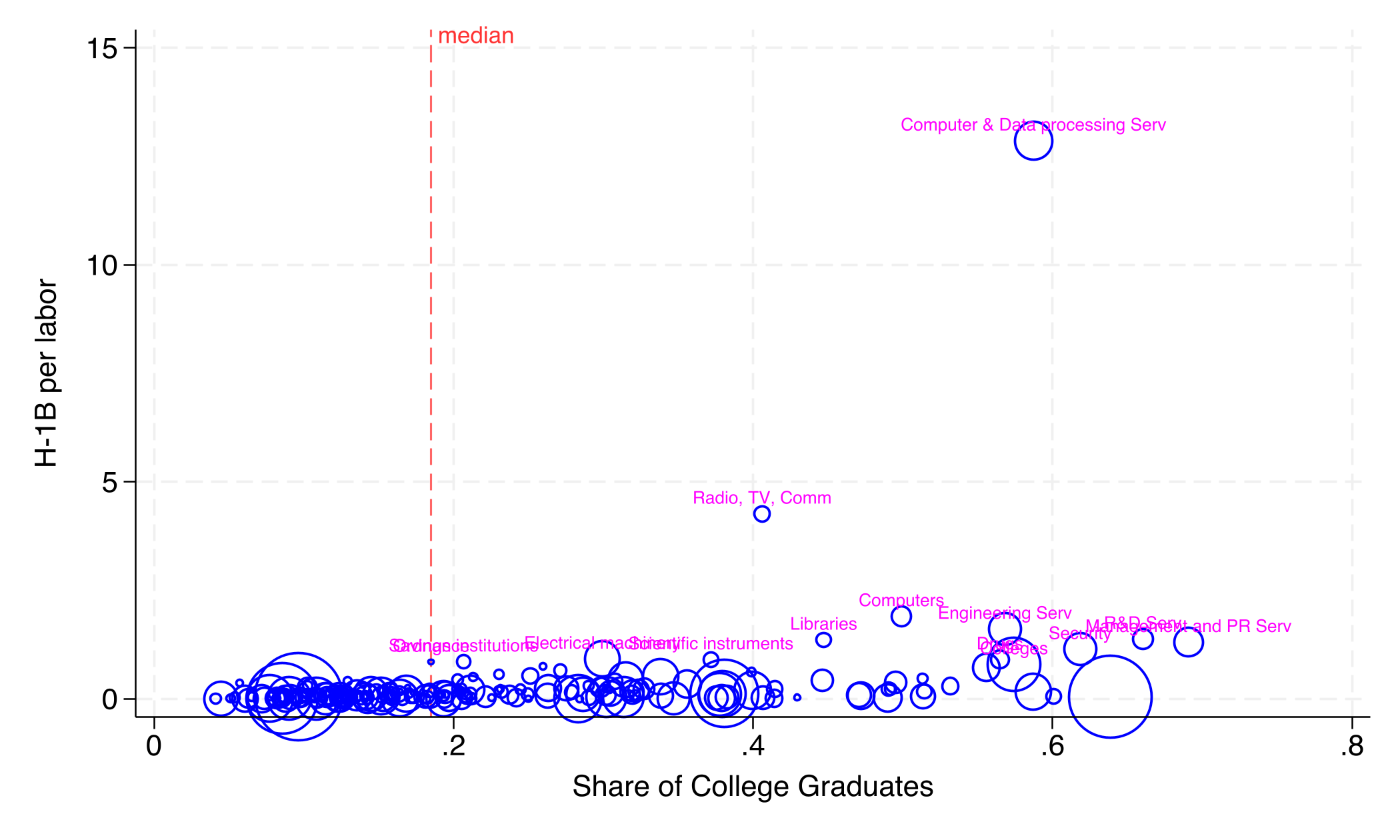
There is one more challenge: pre-trends. The H-1B cap was relaxed during the dot-com boom: there was an increasing need for particular skills, so Congress raised the visa cap to bring more people in. The industries that would eventually be exposed to H-1B workers were already following different trajectories, resulting in the standard pre-trend problem. To address this, we use the reduced-form version of SIV. For every industry, we find synthetic control weights among industries in the same skill group by matching on the trends in outcomes, build a synthetic industry with these weights, difference it out from the real data, and apply OLS to the differenced data. Because there are few effective clusters, inference is through randomization (Ferman and Pinto, 2019).
Results
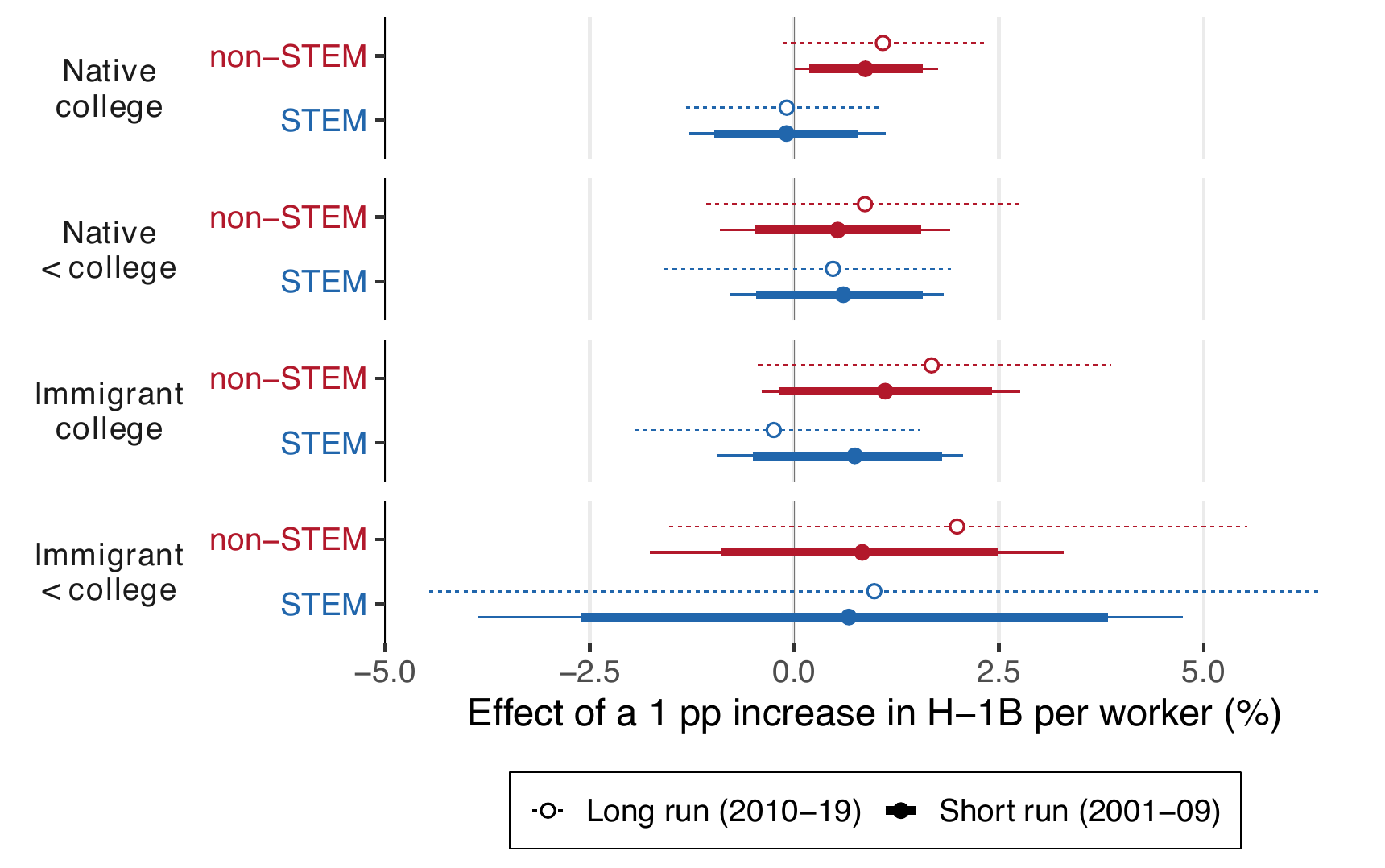
We first look at the “direct” effects of H-1B exposure. We compare industries that are more and less exposed to H-1B workers, before and after the H-1B cap relaxation, while controlling for skill-time fixed effects and for unobserved confounding via synthetic controls. Our outcomes are the earnings of natives and pre-existing immigrants, where we distinguish between low- and high-skill workers, and between those in STEM and non-STEM occupations. We find that H-1B immigration increases natives' earnings in non-STEM occupations, with no detectable impact in STEM occupations.
We then trace out forward and backward propagation, using two different datasets (QCEW and ACS). We control for each industry's own direct exposure and compare industries that are differentially exposed to forward and backward G.E. forces. We find that forward exposure brings large gains, while backward exposure has a null effect. Compare this to the low-skill immigration shock in Turkey, where both forward and backward trading partners benefited.
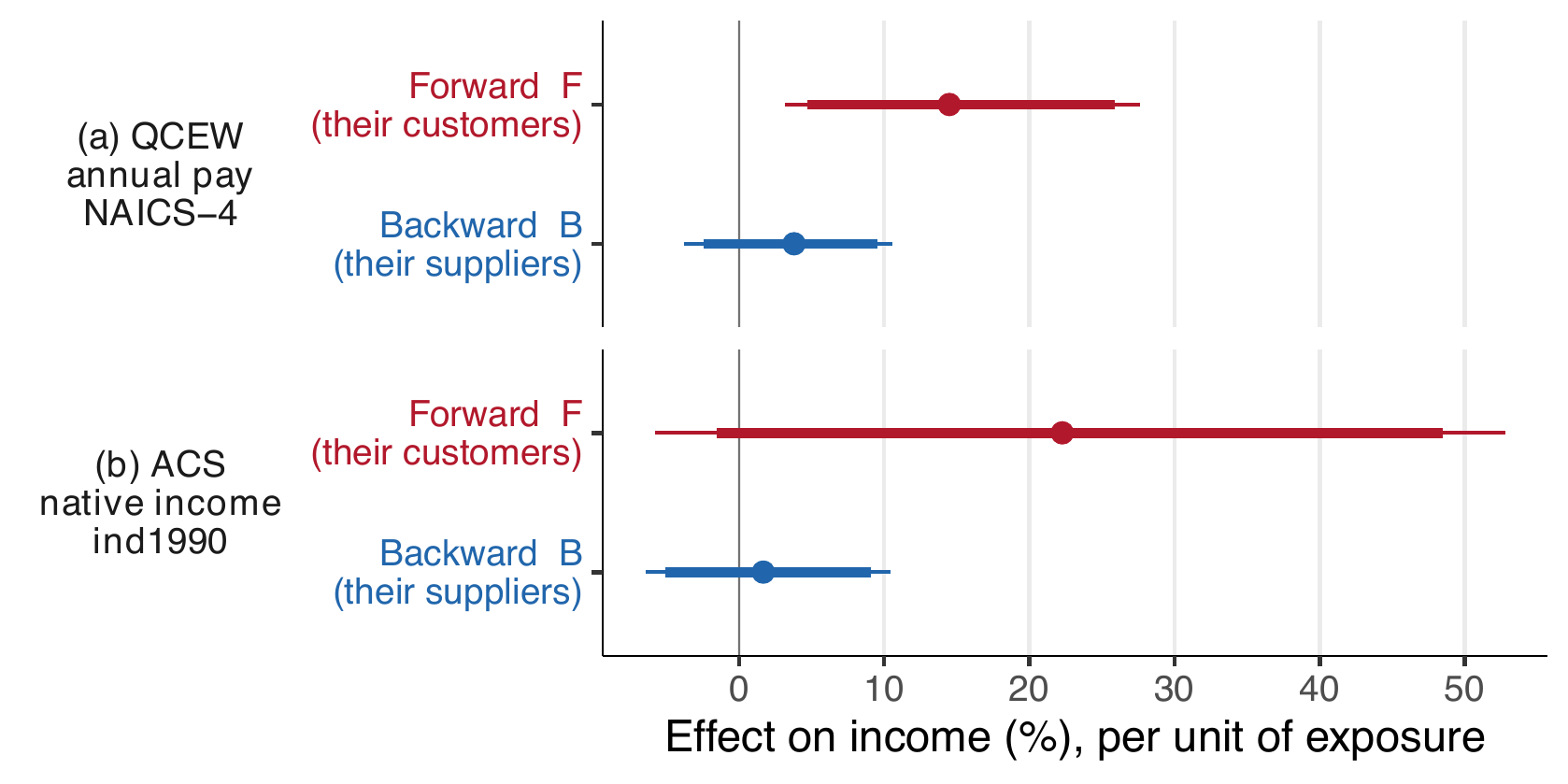
It is worth taking a second to understand the importance of these results. The debate about H-1B workers is over the seats they occupy: whether they take jobs that could otherwise go to native workers. What forward propagation shows in the data is that industries that never rely on H-1B workers also benefit from them.
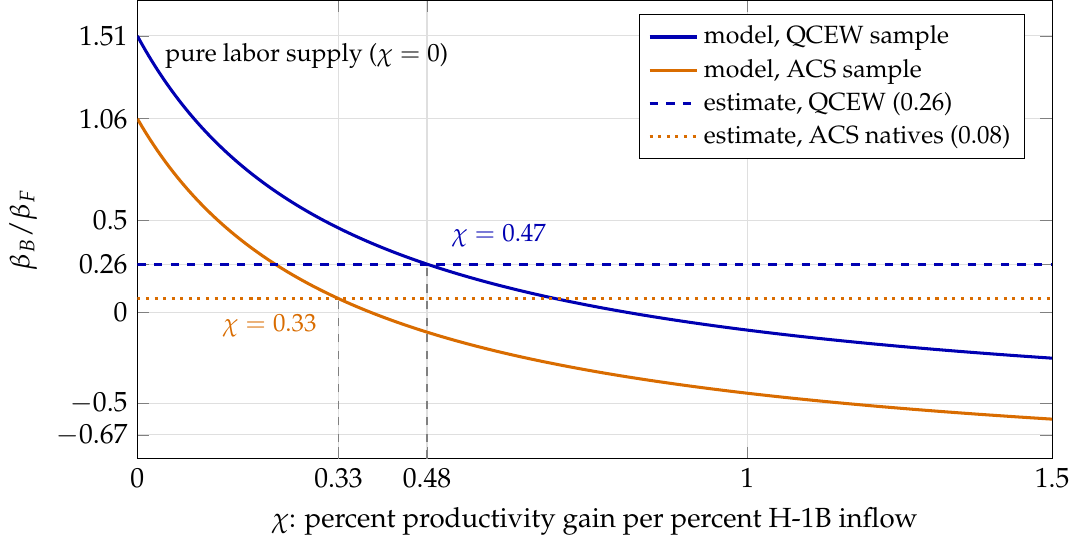
Let's take these forward and backward effects to the model and ask what they imply for productivity. In the model, we simulate a pure labor supply shock, calculate what the coefficients on backward and forward exposure would capture in a regression, and take their ratio (backward over forward). This is the ratio we would have seen absent productivity gains (and sampling noise). As we let H-1B immigrants provide more productivity, the backward effect decreases and the forward effect increases, making the ratio smaller. The point at which these curves cross our point estimates is the productivity gain from H-1B immigration implied by our results.
Policy
Recent policies have focused on restricting the program (Bloomberg Law). Based on our estimates and our model, what would be the expected consequences of these restrictions? We simulate an economy in which the H-1B program suddenly stops, resulting in 85,000 fewer H-1B workers each year.
What 85,000 fewer H-1B workers a year would cost, every year
| Labor supply in computer services | −1.1% |
| Productivity in computer services | −0.5% |
| Income of non-STEM native college graduates there | −1.2% |
| Income in customer industries | −0.5% (1997 network), −0.7% (2017) |
| Real GDP | −0.13%, of which −0.07% productivity |
H-1B is not only immigration policy. It is technology policy.
Restricting it is less like shielding workers from cheap labor, and more like slowing a technology the whole economy runs on.
Related paper
Immigration, Housing, and Voting: Evidence from Canada's Post-2015 Immigration Surge
With Jeremy Ferwerda and Jens Hainmueller.
Canada's permanent resident admissions rose from about 270,000 in 2015 to over 480,000 in 2024, following the introduction of the Express Entry system. We study how this surge affected local rents and voting behavior, and how much of the effect on voting runs through the housing market. To identify the effect on rents, we build on the standard past-settlement instrument in two ways: we exploit the policy-induced surge in admissions, and we relax the share-exogeneity assumption embedded in the instrument using Synthetic IV. We find that immigration raises rents in regions with tight labor markets and in regions where geographic constraints make housing supply inelastic. We are currently extending the analysis to house prices, vacancies, and new construction. We will then estimate the effects on voting and use variation in housing supply elasticity to isolate the role of rents in shaping political responses to immigration.
Refugee Crises
My work on immigration began with the refugee crises of the past decade and a question they raised: what are the consequences of granting or denying refugees work permits for the host economy? I study this question in the two largest refugee crises in the world: 3.6 million Syrians in Turkey and 2.5 million Venezuelans in Colombia.
Formal Effects of Informal Labor and Work Permits: Evidence from Venezuelan Refugees in Colombia
With Dany Bahar and Isabel Di Tella. Journal of Labor Economics, forthcoming. [PDF]
We analyze the Venezuelan refugee crisis in Colombia to separate the labor market effects of informal immigration and work permits. Using Synthetic Instrumental Variables, we find informal immigration displaced natives from both informal and formal sectors, implying high substitutability between worker types (elasticity ≈ 10). A triple difference-in-differences shows work permits reduced competition in the informal sector and raised it in the formal sector. Our model implies this created 23,100 formal jobs and roughly $42 million in annual tax revenue, which provides an economic rationale for granting refugees the right to work.
Formal Effects of Informal Labor: Evidence from Syrian Refugees in Turkey
Revise and resubmit, Journal of Human Resources. [PDF]
I study the effects of Syrian refugees, who are denied work permits and thus can only work informally, on Turkish firms and workers. Using travel distance as an instrument for refugee location, I show that low-skill natives lose both informal and formal salaried jobs. I document two mechanisms: formal firms reduce their formal labor demand and new firms do not enter the formal economy. Estimates imply an elasticity of substitution of 10 between formal and informal workers. Counterfactual exercises predict that granting refugees work permits would have created up to 120,000 formal jobs in the economy through higher informal wages.
No Way Back? Reallocation Frictions and Asymmetric Adjustment to Refugee Arrivals and Returns
With Sarah Winton. Data acquisition in progress.
The fall of the Assad regime in December 2024 triggered a large, unanticipated return of Syrian refugees from Jordan, reversing the labor supply shock their arrival created a decade earlier. Using novel returns data matched to Syrian refugees' individual work experience, skills, and credentials, we study whether host-country labor markets adjust symmetrically to refugee arrivals and departures, or whether downward wage rigidity, irreversible investments, and sectoral reallocation frictions make adjustment to departures slow and incomplete.
Remote Work and Gender Inequality
My other line of research studies child penalties: the disparate impact of parenthood on women's labor market outcomes relative to men's. In developed countries, these penalties explain much of the gender inequality in the labor market. We do not yet know which occupations they come from, or whether technological changes that make occupations more flexible, such as remote work, can reduce them.
Occupational Heterogeneity of Child Penalty in the United States
Submitted. [PDF]
I investigate how parenthood reshapes employment patterns across occupations and how this occupational heterogeneity contributes to earning disparities. Using a novel rotating panel approach to estimating child penalties, I document that both men and women change occupations. The well-established null effect of fatherhood hides that men's employment rate decreases in some occupations like finance and increases in others like construction. Women leave most occupations but select into occupations with part-time options. These occupational changes explain 40% of the income penalty for women, most of the income penalty for men, and most of the wage penalty for both genders.
Effect of Remote Work on the Child Penalty: Evidence from the United States
With Christina Langer. Submitted. [PDF]
We study the effect of the post-COVID expansion of remote work on the child penalty. Our empirical design proceeds in three steps: using pseudo-panels to estimate child penalties across occupations, exploiting cross-occupational variation in remote work adoption, and using synthetic controls to adjust for differential pre-COVID trajectories. Remote work reduces the hours penalty for mothers: each percentage point increase in an occupation's remote work share raises mothers' hours worked by 0.19%, eliminating one-seventh of the baseline hours penalty for the average remote occupation. We find no effects on employment, income, or wages for mothers, and no average effects on men.
Remote Work and Fathers' Long Hours: Evidence from the United Kingdom
Draft coming soon.
I study how the post-pandemic expansion of remote work changed the child penalty in the United Kingdom. I estimate child penalties by occupation from the Labour Force Survey and correct for differences in pre-pandemic trends using synthetic controls. Remote work reduced the probability that fathers work long hours relative to childless men. The effect is concentrated between 38 and 49 hours a week and appears nowhere else in the hours distribution. I find no effect on mothers. This reverses the pattern in the United States, where remote work raised mothers' hours and left men unaffected.
Remote Work, Gender Norms, and the Child Penalty
With Natalie Irmert and Christina Langer.
We test whether gender norms and family institutions shape how remote work changes the child penalty. Comparisons across countries mix up norms and institutions, so we pair them with a design inside one country that holds institutions fixed. Across roughly twenty countries, we estimate child penalties by occupation from labor force surveys and administrative data, correct for differences in pre-pandemic trends using synthetic controls, and relate the effect of remote work to pre-pandemic norms and institutions. Within Sweden, we use population registers to compare children of immigrants whose parents come from countries with different gender norms, but who share the same labor market, family policies, and employers. The registers also record parental leave and days caring for a sick child, taken by each parent. Funded by an LSE Remote and Distributed Work Research Initiative grant.